Horizontal Integration Tutorial for SM Data
This tutorial demonstrates the process of horizontally integrating spatial metabolomics (SM) data using spatialMETA. Horizontal integration is a powerful technique to address batch effects.
[1]:
cd ..
/home/rolan/Documents/spatialMETA
/home/rolan/miniconda3/envs/spatialtk/lib/python3.9/site-packages/IPython/core/magics/osm.py:417: UserWarning: using dhist requires you to install the `pickleshare` library.
  self.shell.db['dhist'] = compress_dhist(dhist)[-100:]
[2]:
import spatialmeta as smt
from spatialmeta.model import AlignmentVAE
import numpy as np
import pandas as pd
import scanpy as sc
import torch
import copy
import matplotlib.pyplot as plt
[3]:
RCC_sample_list = ["R114_T","S15_T","X49_T","Y27_T","Y7_T"]
Read and proprocess data
Read and merge data
In this step, we read and merge the SM data for each sample.
[15]:
# If data is available
for i in RCC_sample_list:
    adata_SM = sc.read_h5ad("./spatialmeta_tutorial/data/ccRCC_samples/adata_SM_"+i+"_raw.h5ad")
    adata_name = "adata_SM_"+i
    globals()[adata_name] = adata_SM
[ ]:
#Test data can be obtained from SpatialMETA
for i in RCC_sample_list:
    adata_SM = smt.data.load_adata(
        sample_name= i+"_raw",
        modality="SM"
    )
    adata_name = "adata_SM_"+i
    globals()[adata_name] = adata_SM
[16]:
merge_SM_adata = anndata.concat({
"R114_T":adata_SM_R114_T,
"S15_T":adata_SM_S15_T,
"X49_T":adata_SM_X49_T,
"Y27_T":adata_SM_Y27_T,
"Y7_T":adata_SM_Y7_T,
},label="sample")
/home/rolan/miniconda3/envs/spatialtk/lib/python3.9/site-packages/anndata/_core/anndata.py:1828: UserWarning: Observation names are not unique. To make them unique, call `.obs_names_make_unique`.
  utils.warn_names_duplicates("obs")
[17]:
merge_SM_adata.write_h5ad("./spatialmeta_tutorial/data/ccRCC_merge_SM.h5ad")
Normalize merge data
In this step, we normalize the merged data.
[18]:
merge_SM_adata.layers["counts"] = merge_SM_adata.X.copy()
[19]:
sc.pp.normalize_total(
    merge_SM_adata,
    target_sum = 1e4
)
[20]:
merge_SM_adata.layers["normalized"] = merge_SM_adata.X.copy()
Calculate SVMs and remove batch-baised SVMs
We also calculate spatial bariable metabolites(SVMs) to identify features that exhibit spatial variation. In addition, we remove those that are batch-biased.
[21]:
smt.pp.spatial_variable(merge_SM_adata,
                        n_top_variable=800,
                        add_key = "highly_variable_moranI",
                        batch_key="sample",
                        min_samples = 3,
                        min_frac = 0.9,
                        min_logfc= 3
                       )
[22]:
merge_SM_adata = merge_SM_adata[:,merge_SM_adata.var.highly_variable_moranI]
[23]:
merge_SM_adata
[23]:
View of AnnData object with n_obs × n_vars = 72336 × 697
    obs: 'x_coord_original', 'y_coord_original', 'total_intensity_pos', 'mean_intensity_pos', 'total_intensity_neg', 'mean_intensity_neg', 'spot_index', 'total_intensity', 'mean_intensity', 'sample'
    var: 'highly_variable_moranI'
    uns: 'rank_genes_groups'
    obsm: 'spatial', 'spatial_normalized', 'spatial_transformed', 'spatial_transformed_scaled'
    layers: 'counts', 'normalized'
[24]:
merge_SM_adata.write_h5ad("./spatialmeta_tutorial/data/ccRCC_merge_SM_hvm.h5ad")
ConditionalVAESM for horizontal integration for SM
In this step, we perform horizontal integration using the ConditionalVAESM model.
[25]:
merge_SM_adata.X = merge_SM_adata.layers['normalized']
[26]:
merge_SM_adata.var['type'] = "SM"
/tmp/ipykernel_38705/2257733875.py:1: ImplicitModificationWarning: Trying to modify attribute `.var` of view, initializing view as actual.
  merge_SM_adata.var['type'] = "SM"
/home/rolan/miniconda3/envs/spatialtk/lib/python3.9/site-packages/anndata/_core/anndata.py:1828: UserWarning: Observation names are not unique. To make them unique, call `.obs_names_make_unique`.
  utils.warn_names_duplicates("obs")
/home/rolan/miniconda3/envs/spatialtk/lib/python3.9/site-packages/anndata/_core/anndata.py:1828: UserWarning: Observation names are not unique. To make them unique, call `.obs_names_make_unique`.
  utils.warn_names_duplicates("obs")
[27]:
model = smt.model.ConditionalVAESM(merge_SM_adata,
                                       n_latent=10,
                                       device='cuda:0',
                                       batch_keys="sample",
                                       batch_embedding="embedding"
                                      )
[28]:
loss_dict = model.fit(
    max_epoch=64,
    lr=1e-3,
    kl_loss_reduction= 'mean',
    kl_weight = 15,
    n_epochs_kl_warmup = 0
)
/home/rolan/Documents/spatialMETA/spatialmeta/util/logger.py:151: TqdmWarning: IProgress not found. Please update jupyter and ipywidgets. See https://ipywidgets.readthedocs.io/en/stable/user_install.html
  from tqdm.autonotebook import tqdm as tqdm_notebook
Epoch 64: 100%|██████████| 64/64 [02:15<00:00,  2.12s/it, reconst=4.33e+03, kldiv=5.57e+02, total_loss=4.89e+03]
Visualization and analysis
[32]:
Z = model.get_latent_embedding()
X = model.get_normalized_expression()
Latent Embedding: 100%|██████████| 566/566 [00:00<00:00, 925.73it/s]
Latent Embedding: 100%|██████████| 566/566 [00:01<00:00, 511.62it/s]
[33]:
merge_SM_adata.layers['reconstruction'] = X
merge_SM_adata.obsm['X_emb']=Z
[35]:
sc.pp.neighbors(merge_SM_adata,use_rep="X_emb",n_neighbors=15)
sc.tl.umap(merge_SM_adata,
          min_dist=1,spread=1)
sc.tl.leiden(merge_SM_adata,
             key_added="VAE_clusters_latent10")
/home/rolan/miniconda3/envs/spatialtk/lib/python3.9/site-packages/umap/distances.py:1053: NumbaDeprecationWarning: The 'nopython' keyword argument was not supplied to the 'numba.jit' decorator. The implicit default value for this argument is currently False, but it will be changed to True in Numba 0.59.0. See https://numba.readthedocs.io/en/stable/reference/deprecation.html#deprecation-of-object-mode-fall-back-behaviour-when-using-jit for details.
  @numba.jit()
/home/rolan/miniconda3/envs/spatialtk/lib/python3.9/site-packages/umap/distances.py:1061: NumbaDeprecationWarning: The 'nopython' keyword argument was not supplied to the 'numba.jit' decorator. The implicit default value for this argument is currently False, but it will be changed to True in Numba 0.59.0. See https://numba.readthedocs.io/en/stable/reference/deprecation.html#deprecation-of-object-mode-fall-back-behaviour-when-using-jit for details.
  @numba.jit()
/home/rolan/miniconda3/envs/spatialtk/lib/python3.9/site-packages/umap/distances.py:1076: NumbaDeprecationWarning: The 'nopython' keyword argument was not supplied to the 'numba.jit' decorator. The implicit default value for this argument is currently False, but it will be changed to True in Numba 0.59.0. See https://numba.readthedocs.io/en/stable/reference/deprecation.html#deprecation-of-object-mode-fall-back-behaviour-when-using-jit for details.
  @numba.jit()
/home/rolan/miniconda3/envs/spatialtk/lib/python3.9/site-packages/umap/umap_.py:646: NumbaDeprecationWarning: The 'nopython' keyword argument was not supplied to the 'numba.jit' decorator. The implicit default value for this argument is currently False, but it will be changed to True in Numba 0.59.0. See https://numba.readthedocs.io/en/stable/reference/deprecation.html#deprecation-of-object-mode-fall-back-behaviour-when-using-jit for details.
  @numba.jit()
/tmp/ipykernel_38705/181838692.py:4: FutureWarning: In the future, the default backend for leiden will be igraph instead of leidenalg.

 To achieve the future defaults please pass: flavor="igraph" and n_iterations=2.  directed must also be False to work with igraph's implementation.
  sc.tl.leiden(merge_SM_adata,
[36]:
sc.settings.set_figure_params(dpi=200, facecolor="white")
fig,ax=plt.subplots()
fig.set_size_inches(5,5)
sc.pl.umap(merge_SM_adata,color=["sample"],
          palette = {
              "R114_T": "#F97300",
              "S15_T": "#7469B6",
              "X49_T": "#7ABA78",
              "Y27_T": "#03AED2",
              "Y7_T": "#F3CA52",
          },
          show = False,
          size = 3,
          ax=ax)
[36]:
<Axes: title={'center': 'sample'}, xlabel='UMAP1', ylabel='UMAP2'>

[37]:
sc.settings.set_figure_params(dpi=200, facecolor="white")
fig,ax=plt.subplots()
fig.set_size_inches(5,5)
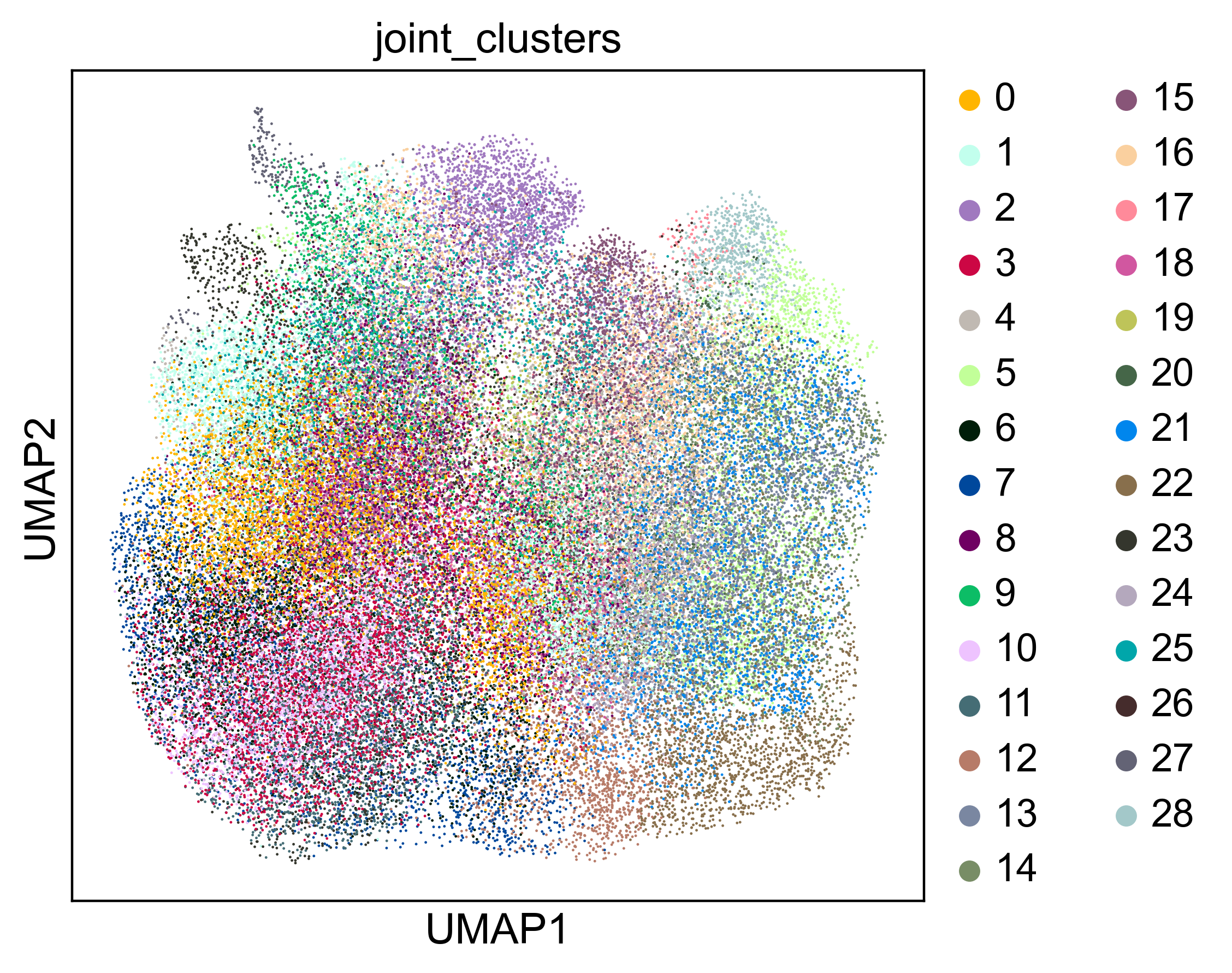
sc.pl.umap(merge_SM_adata,color=["joint_clusters"],
          palette = sc.pl.palettes.godsnot_102[40:],
          show = False,
          size = 3,
          ax=ax)
[37]:
<Axes: title={'center': 'joint_clusters'}, xlabel='UMAP1', ylabel='UMAP2'>
[38]:
merge_SM_adata.write_h5ad("./spatialmeta_tutorial/data/ccRCC_merge_SM_hvf_afterVAE.h5ad")